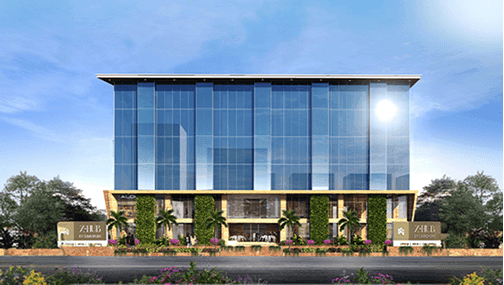
Sumadhura Group leases Grade-A office and retail space at three Whitefield addresses — Capitol Towers at Hope Farm Junction, Hive and Thrive at Hoodi Junction and SST Z-Hub off ITPB Main Road — with office suites from 410 sq ft to 3,830 and retail units from 410 to 3,400. Two are walkable to Purple Line stations, one is ready for occupation today, and Capitol Towers is an office campus with no retail component of its own.
An occupier arriving here is usually solving for four things in a fixed order: a floor that fits the team, a commute the team will accept, a date the space is available, and a rate. A retailer is solving a different problem entirely — who walks past, at what hours, and whether the unit can physically carry their format. The buildings below answer both questions, but not equally, and the second half of this page sets out where they differ.
Worth settling before the shortlist. Capitol Towers is leased only; nothing there is sold, and it is office space throughout. Hive and Thrive and Z-Hub each offer office and retail on both a lease and a sale basis, so a tenant and a buyer can be looking at the same floor plate for different reasons. If ownership is the objective, the sale page covers those two assets on those terms.
Retail here lives or dies on who is already upstairs. A unit inside a mixed-use building starts with a captive weekday population — the people working on the office floors, and at Z-Hub the residents living above them — before a single passing customer is counted. That is what separates retail space in Whitefield inside an office development from a standalone shop on a main road, where footfall has to be won from scratch every day.
Two clauses decide most of what a lease actually costs. Shell condition comes first: a bare shell is a slab, a core and services brought to the floor, while a warm shell adds flooring, false ceiling, basic HVAC distribution and lighting — a difference worth ₹400 to ₹800 a square foot in fit-out. Then the quoted area: ask whether it is chargeable or carpet, and what the loading factor between them is, because a 35% loading against a 25% one moves the real rate further than most rent negotiations do.
A retailer has a further set, and permitted use is the one to settle in writing before anything else — food service and clinics carry requirements a general retail unit may not meet, and a lease signed against the wrong permitted use cannot be fixed afterwards. Sanctioned electrical load, water and drainage, a physical ducting route to the roof, frontage width, signage rights, customer parking and the building's trading hours all follow from it.
Whitefield's depth on both counts follows from its history. ITPB opened the corridor, the campuses that followed brought the workforce, and the Purple Line extension gave the belt rail it had done without for 20 years. The result is a market where an occupier can take a Grade-A floor within a few hundred metres of a station, and a retailer can trade to a population that arrives on a schedule and spends at predictable hours.



 Commercial
 Ready to Move
 Grade-A Commercial Space