Why Is Luxury Property Becoming Generational Wealth in India?
By Sofia Sondh · June 12, 2026 · 6 min read

Summary
In India, luxury properties above ₹10 crore in Mumbai, Bangalore and Gurgaon are increasingly treated as generational wealth assets rather than homes, favored by HNIs and NRIs for inflation-resistant, tax-efficient returns. About 76.9% of Indian household wealth sits in property (RBI), with prime residential assets returning 9–11% annually (5–12% for luxury) and Bangalore projecting 12–18% ROI with 3–6% rental yields. Tax benefits include Section 24(b) interest deductions and DTAA coverage across 90+ countries for NRIs. Sumadhura structures projects like Palais Royale (Hyderabad) and Folium (Whitefield, Bangalore) as succession-ready legacy assets near IT hubs and metro connectivity.
Across Mumbai, Bangalore and Gurgaon, residences priced above ₹10 crore are now treated as strategic financial assets rather than simply homes. NRIs and experienced local investors are driving demand for properties that offer an inflation-resistant store of value, and because their focus is on long-term growth and tax efficiency, these high-value homes often become the base of a family estate. In 2026, luxury real estate continues to be a leading choice for families securing their financial future across India’s fast-changing cities.
The data behind the shift (attribute each figure to a source before publishing)
| Signal | Figure |
|---|---|
| Household wealth held in property/land (RBI) | ~76.9% |
| India residential price growth, Q1 2025 (YoY) | 7.7% |
| Prime residential historic annual growth | 9–11% |
| Luxury property historic annual returns | 5–12% |
| Rental yields — national / Bangalore | 2–4% / 3–6% (3–5% near IT corridors) |
| Bangalore projected annualised ROI | 12–18% |
| Luxury housing market by 2030 [verify] | $124.2B (21.81% CAGR) |
What Defines Generational Wealth in India?
Generational wealth is about preservation and transfer as much as accumulation. It means deliberately acquiring appreciating, income-generating tangible assets that can be legally and structurally passed to the next generation. Real estate has long served as a “brick-and-mortar bank” that compounds steadily through capital appreciation, stable rental income, tax-efficient ownership, inflation-adjusted growth and clear succession planning. The distinction between ordinary wealth and generational wealth lies in durability: wealth can fluctuate with markets, while a well-chosen property compounds quietly through the cycles that shake financial instruments.
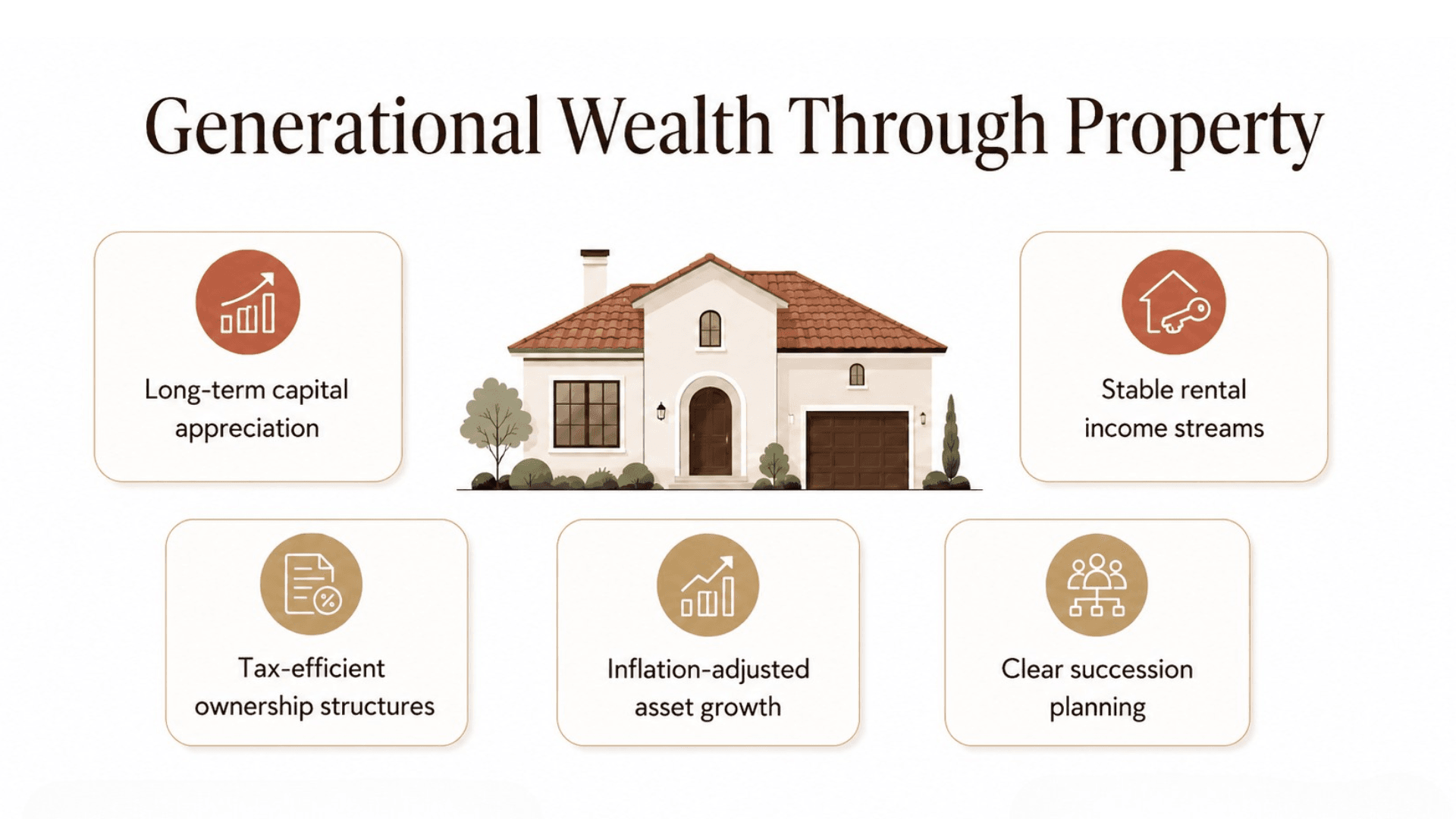
The five ways property compounds into generational wealth.
Why Does Real Estate Dominate Indian Household Wealth?
Even as equities and mutual funds gain ground, Indian households continue to anchor their wealth in physical assets. Around 76.9% of household wealth sits in property and land, and even among the poorest 20%, 59% own a dwelling or plot — ownership that transcends income levels and functions as cultural infrastructure. While buyers weigh financial metrics such as ROI, EMI and yield, the deeper drivers are psychological and cultural: tangible ownership offers a security that intangible instruments rarely match. For most Indian families, a home is bought with a thirty-year or multi-generational horizon in mind.
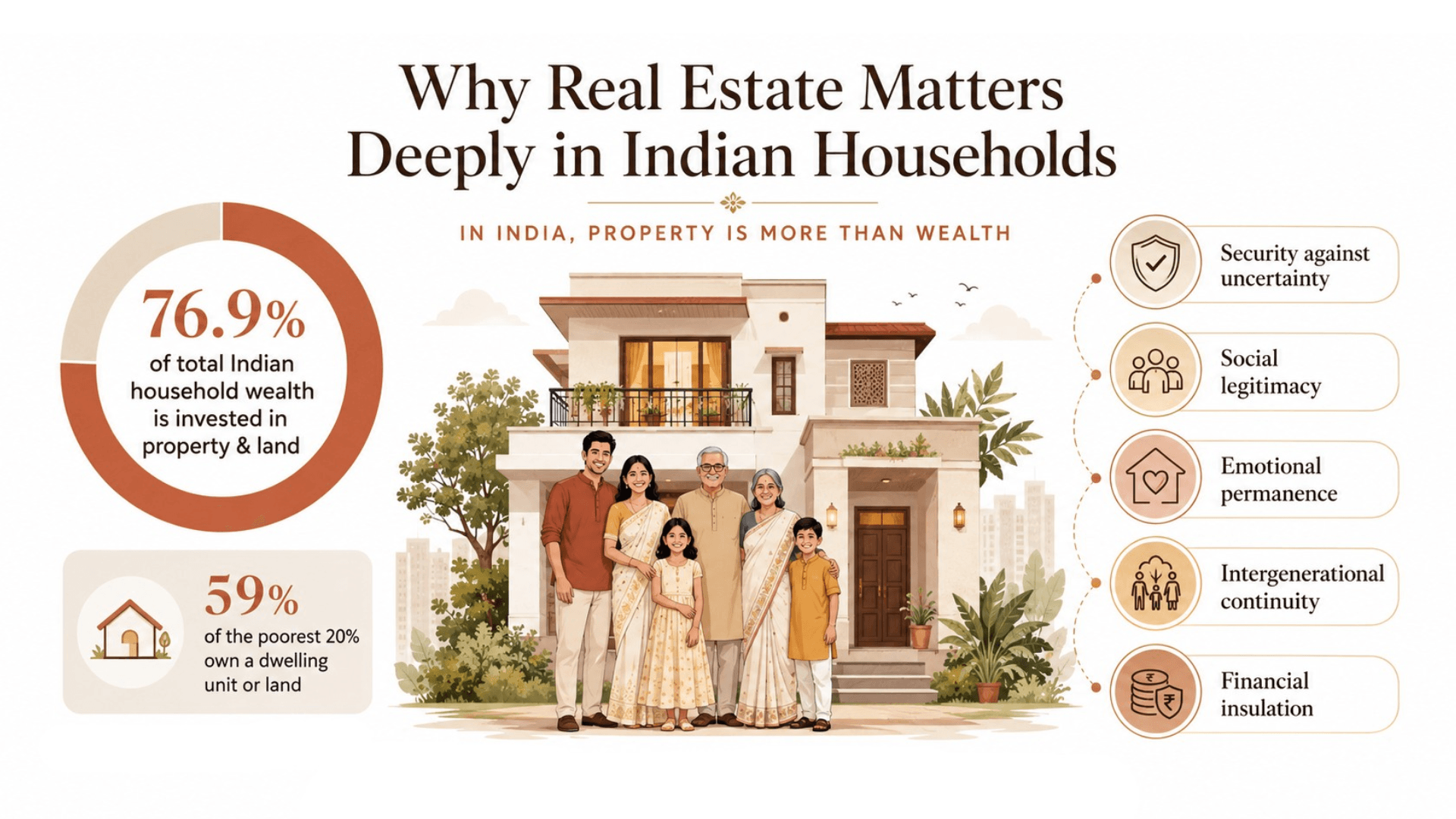
Why real estate matters deeply in Indian households — 76.9% of wealth is held in property and land. (Figures also in the table above.)
These returns are structural rather than speculative, driven by urbanisation, the scarcity of prime land, infrastructure-led price discovery and rising HNI and NRI participation. In FY25, Bangalore’s luxury market alone crossed ₹1,000 crore in sales, underlining how durable this demand has become.
What Tax Advantages Make Luxury Property Efficient to Hold?
| Provision | Benefit |
|---|---|
| Section 24(b) | Interest deduction up to ₹2 lakh/yr (self-occupied); against rental income for let-out, loss capped at ₹2 lakh/yr |
| Section 80C | Principal repayment eligible for deduction |
| Double Taxation Avoidance Agreement (DTAA), for NRIs | Agreements with more than 90 countries prevent double taxation on India-sourced income |
Structured through family trusts or considered succession planning, luxury property becomes a legally optimised legacy asset — one that can pass to heirs with clarity rather than dispute.
Why Does Bangalore Compound Wealth So Reliably?
Among Indian metros, Bangalore stands out as a long-term wealth multiplier, driven by structural factors: a global technology base, an expanding metro (Purple Line operational, Blue Line upcoming), airport-led North Bangalore development, strong foreign direct investment, and about 29% of NRI property investors favouring the city.
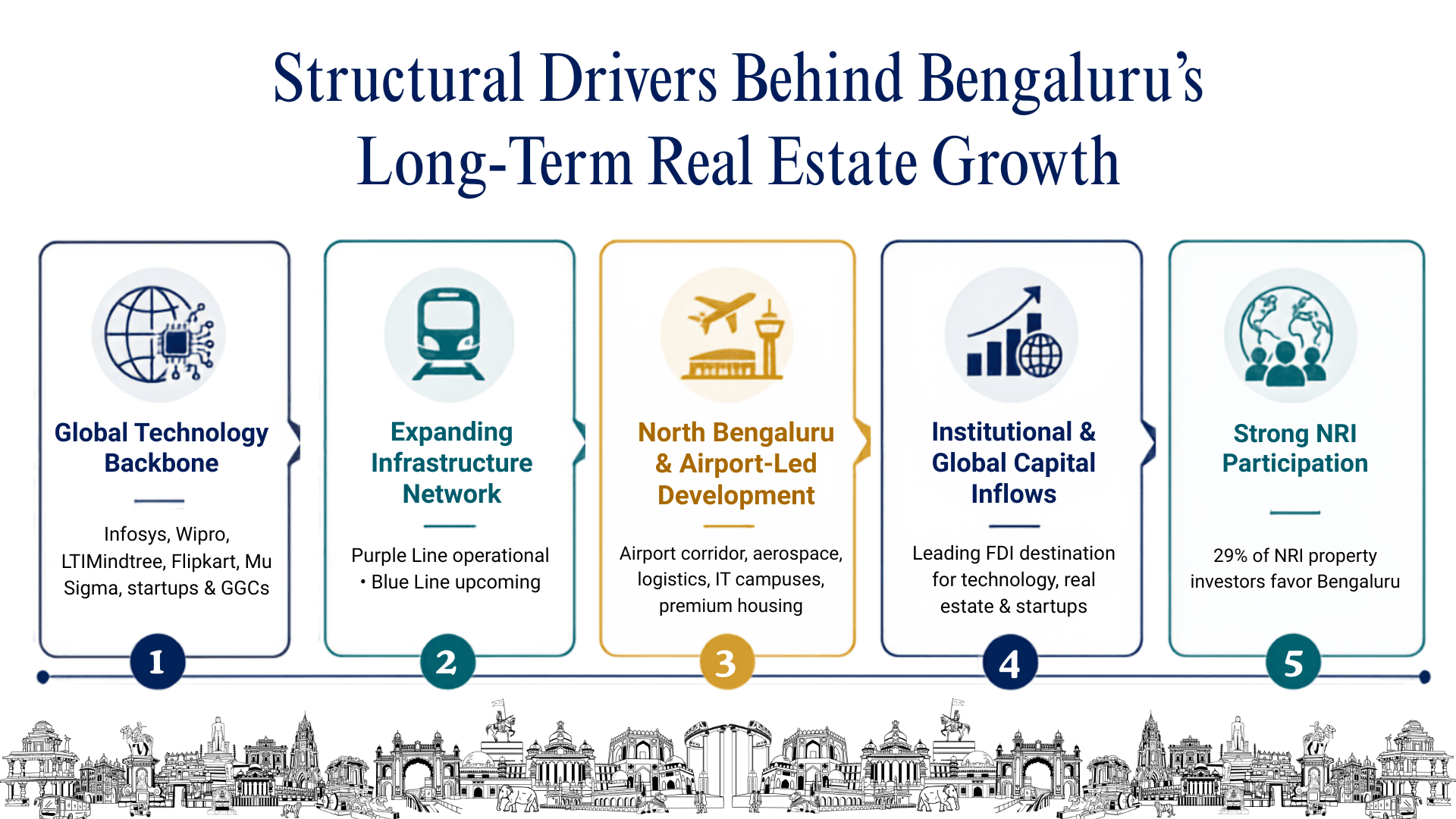
The structural drivers behind Bangalore’s long-term real estate growth.
Bangalore’s projected annualised ROI of 12–18% sits ahead of several metros, with rental yields of 3–6% (and 3–5% near the main IT corridors) and historic prime-asset growth of 9–11%. Millennials and Gen Z accounted for over 60% of purchases in early 2024, a trend expected to hold into 2026 — a young, high-earning buyer base that keeps demand for quality homes resilient.
How Should You Build Generational Wealth in Bangalore?
Long-term wealth creation here rewards strategic asset selection over opportunistic buying. Land in North Bangalore, especially near the airport, is a cornerstone of multi-generational wealth: projects such as Sumadhura Panorama capture land’s scarcity advantage, which often outperforms built assets over long horizons. For buyers who want appreciation and income together, larger, well-designed homes are the natural vehicle — which is exactly why buying a larger home is a long-term life upgrade, not merely a lifestyle one.
How Does Sumadhura Fit a Legacy Strategy?
Sumadhura designs its projects as long-term wealth assets rather than short-term investments. Sumadhura Palais Royale in Hyderabad’s Financial District suits NRIs and HNI families seeking a durable hold, with access to the Nanakramguda and Puppalguda IT campuses. Folium by Sumadhura in Whitefield, Bangalore offers connectivity to IT hubs, schools, hospitals and the Purple Line metro, supporting both everyday convenience and long-term appreciation — the twin qualities a legacy asset needs.
By Sofia Sondh · June 12, 2026 · 6 min read